
Chickens

Scientific Name
Gallus gallus domesticus
Industry Term
Broiler (Ross 308, Cobb 500, Hubbard Flex)
Common
Chicken (used as "meat" chicken)
Origin
Red jungle fowl (Gallus gallus)


Who are they?
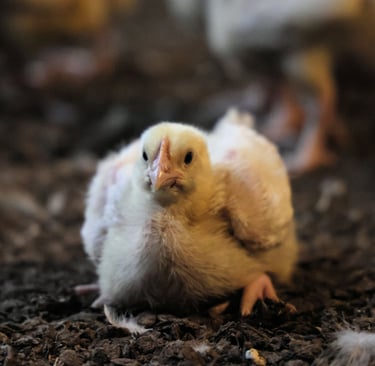
Chickens are intelligent, social birds descended from jungle fowl. They can solve problems, understand time, and communicate through at least 24 distinct vocalisations¹. They form lifelong bonds, show empathy, and experience complex emotions including grief². Chickens are capable of living up to 10 years, but broilers, selectively bred for rapid growth, would often not survive to an unexploited lifespan even without slaughter³.
Chickens bred for meat are confined in sheds by the tens of thousands, suffer severe skeletal, metabolic and skin disorders, and are slaughtered at 6-8 weeks old⁴.
Selective breeding and excessive feeding has pushed growth rates roughly fourfold since the 1960s⁶. US data shows up to 90% of chickens have an abnormal gait by slaughter age⁸; applied to Australia's ~756 million annual slaughter⁷, this suggests roughly 226-230 million birds experience impaired mobility from skeletal issues. Birds commonly become too heavy to stand, spending 76-86% of their time lying down by 5-7 weeks old⁹, developing ammonia burns and foot pad dermatitis from constant contact with soiled litter⁵.
Sudden Death Syndrome affects an estimated 0.5-4% of broilers globally¹⁰; in Australia's ~756 million annual slaughter, this could mean up to 30 million birds die from metabolic failure. Pulmonary hypertension, where the heart and lungs cannot keep pace with body growth, causes extreme swelling, respiratory distress, and cyanosis¹¹.
Sheds confine up to 40,000-60,000 birds in Australia¹². Birds live on the same soiled litter their entire lives, causing ammonia burns to eyes and skin. Poor air quality causes respiratory disorders and eye infections⁵.
Transport and slaughter. US studies show approximately 0.46% of birds arrive dead on arrival at slaughterhouses¹³. Applied to Australia's slaughter numbers, this suggests roughly 2.5-3.5 million birds. At slaughter, birds are shackled upside down and moved through an electrified water bath meant to stun them before their throats are cut, a method that can fail if a bird lifts their head, resulting in the throat being cut while still conscious¹⁴.
How are they Exploited?
References
Page last reviewed: August 2026
Collias, N.E. & Collias, E.C. (1950s-1980s catalogue of chicken vocalisations), as reported in Scientific American, "Fowl Language: AI Decodes the Nuances of Chicken 'Speech'." https://www.scientificamerican.com/article/fowl-language-ai-decodes-the-nuances-of-chicken-ldquo-speech-rdquo/
Edgar, J.L., Lowe, J.C., Paul, E.S., & Nicol, C.J. (2011). Avian maternal response to chick distress. Proceedings of the Royal Society B, 278(1721), 3129-3134. https://doi.org/10.1098/rspb.2010.2701
Olkowski, A.A. (2007). Pathophysiology of heart failure in broiler chickens: structural, biochemical, and molecular characteristics. Poultry Science, 86(5), 999-1005. https://doi.org/10.1093/ps/86.5.999 ; Cheema, M.A., Qureshi, M.A., & Havenstein, G.B. (2003). A comparison of the immune response of a 2001 commercial broiler with a 1957 randombred broiler strain when fed representative 1957 and 2001 broiler diets. Poultry Science, 82(10), 1519-1529. https://doi.org/10.1093/ps/82.10.1519
RSPCA Australia. How are meat chickens farmed in Australia? RSPCA Knowledgebase. https://kb.rspca.org.au/knowledge-base/how-are-meat-chickens-farmed-in-australia/
RSPCA Australia. What are the animal welfare issues with meat chicken farming? RSPCA Knowledgebase. https://kb.rspca.org.au/knowledge-base/what-are-the-animal-welfare-issues-with-meat-chicken-farming/
Zuidhof, M.J., Schneider, B.L., Carney, V.L., Korver, D.R., & Robinson, F.E. (2014). Growth, efficiency, and yield of commercial broilers from 1957, 1978, and 2005. Poultry Science, 93(12), 2970-2982. https://doi.org/10.3382/ps.2014-04291
Australian Chicken Meat Federation. Facts and figures. https://www.chicken.org.au/facts-and-figures/
Kestin, S.C., Knowles, T.G., Tinch, A.E., & Gregory, N.E. (1992). The prevalence of leg weakness in broiler chickens assessed by gait scoring and its relationship to genotype. Veterinary Record, 131(9), 190-194. PMID: 1441174.
The Humane Society of the United States. The Welfare of Animals in the Chicken Industry [Report]. https://www.humanesociety.org/sites/default/files/docs/hsus-report-welfare-chicken-industry.pdf
MSD Veterinary Manual. Sudden death syndrome of broiler chickens. https://www.msdvetmanual.com/poultry/sudden-death-syndrome-of-broiler-chickens/sudden-death-syndrome-of-broiler-chickens
The Poultry Site. Pulmonary hypertension (ascites) syndrome in broiler chickens. https://thepoultrysite.com/publications/diseases-of-poultry/238/pulmonary-hypertension-ascitis-syndrome-in-broiler-chickens
PoultryHub. Meat chicken (broiler) industry. https://www.poultryhub.org/production/meat-chicken-broiler-industry
The Humane Society of the United States. The Welfare of Animals in the Chicken Industry [Report]. https://www.humanesociety.org/sites/default/files/docs/hsus-report-welfare-chicken-industry.pdf
RSPCA Australia. How are meat chickens farmed in Australia? RSPCA Knowledgebase. https://kb.rspca.org.au/knowledge-base/how-are-meat-chickens-farmed-in-australia/

